
On March 4, 1776, James Thacher, Surgeon’s Mate in the Continental Army, stood in the American camp at Roxbury and watched one of the most remarkable military operations of the Revolutionary War begin to unfold before his eyes.
For days the fortifications in and around Boston had been roaring with artillery. In the American lines, from Cambridge to Roxbury, the newly mounted guns brought from Fort Ticonderoga had opened a sustained bombardment of Boston. Cannon and mortars hurled shot across the frozen flats of Back Bay and over the waters of the Charles River. The British guns answered in return. It was the heaviest bombardment Massachusetts had ever witnessed.
The British perhaps suspected that all this was a prelude to an assault on Boston itself. But the cannonade had a different purpose. Washington did not intend to storm Boston. At least not right away. The thunder of artillery was meant to distract the British while the Continental Army prepared a bold maneuver just to the south of the town.
From Roxbury, a narrow strip of land known as Dorchester Neck led to the commanding heights of Dorchester. If the Americans could occupy and fortify those hills, they would dominate Boston Harbor and threaten the British fleet itself. The city would become impossible to hold.
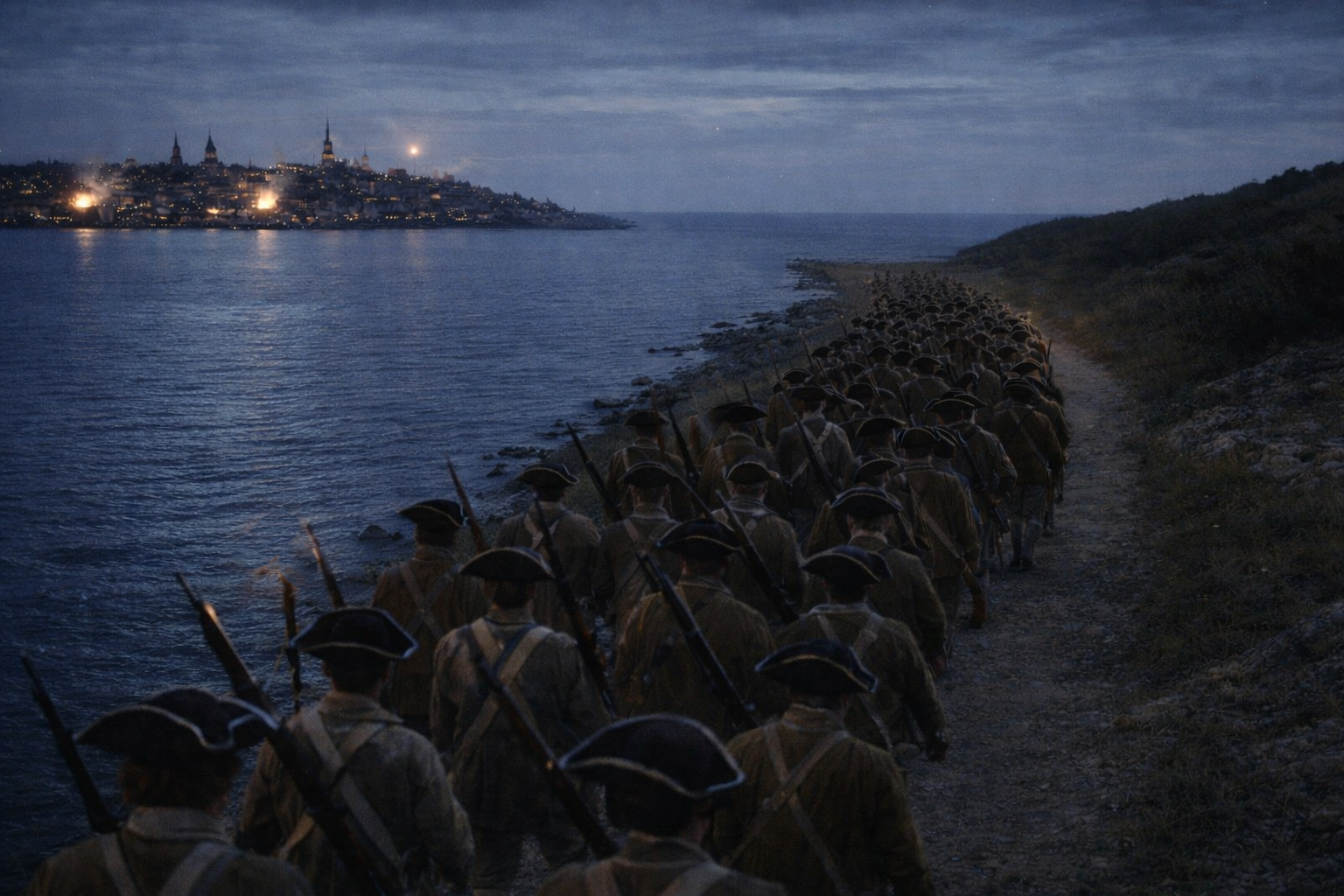
On the evening of March 4, the movement began. Thacher watched as the immense operation slowly formed and set itself in motion: thousands of men, hundreds of carts, teams of oxen, and heavy artillery pieces rumbling toward the narrow road leading to the heights. The cannon fire continued as the columns assembled.
Thacher recorded the moment in his journal:
The object in view is now generally understood to be the occupying and fortifying of the advantageous heights of Dorchester. A detachment of our troops is ordered to march for this purpose this evening ; and our regiment, with several others, has received orders to march at 4 o’clock in the morning, to relieve them. We are favored with a full bright moon, and the night is remarkably mild and pleasant; the preparations are immense; more than three hundred loaded carts are in motion. By the great exertions of General Mifflin, our Quarter Master General, the requisite number of teams has been procured. The covering party of eight hundred men advance in front. Then follow the carts with the entrenching tools; after which, the working party of twelve hundred, commanded by General Thomas, of Kingston.
The officer in command of the operation was General John Thomas of Kingston, Massachusetts on the South Shore. A veteran of the French and Indian War, Thomas had been commanding the Roxbury camp and the right wing of the American lines since the day the siege began in April 1775. Washington respected him, and because the movement onto Dorchester Heights originated from the Roxbury lines, it was Thomas who carried the immense responsibility of executing Washington’s carefully prepared plan.
Thacher continued his description of the great column moving quietly through the moonlit countryside:
Next in the martial procession are a train of carts, loaded with fascines and hay, screwed into large bundles of seven or eight hundred weight. The whole procession moved in near silence and deployed with great efficiency, all while the roar of cannon continued.
The distracted British forces were not aware that the provincials were about to turn Dorchester Heights into a formidable fortress overnight. Dawn the next morning would present a dramatic scene, and the British would look out from Boston at a transformed Dorchester Heights and wonder how it had happened.
But Thacher records more details about that, and the building of the fortifications, in tomorrow’s entry…
 Historical Digression